
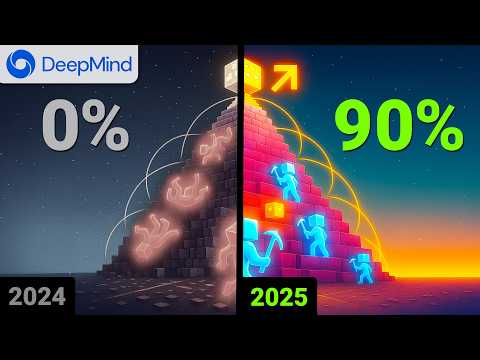
Google DeepMind has made a significant leap in artificial intelligence by creating an AI that excels at playing Minecraft, and it has done so with minimal training data. Unlike previous models that required extensive annotated footage to succeed, this new AI leverages an innovative technique called “imagination training.” This groundbreaking method allows the AI to develop and improve its strategies within a simulated world, much like reflecting on past experiences. This could be a game-changer not only for AI playing video games but also for various real-world applications in robotics and beyond.
Introduction to DeepMind’s New AI
Google DeepMind’s latest AI innovation involves mastering Minecraft through an approach that starkly contrasts with traditional training methods. Historically, AIs required vast amounts of annotated video data to understand and even begin to master a game. DeepMind’s new AI, however, takes a fraction of the time and data, making it a pioneer in the realm of efficient machine learning.
Phases of AI Learning and Training
The learning journey of this AI can be broken down into three significant phases. First is the ‘World Model Pretraining’ phase, where the AI observes a limited amount of gameplay footage to create a mental model or neural simulation of the game environment. In the second phase, ‘Learn what matters,’ the AI employs a feedback system that assigns values to its actions—each successful task, such as mining, earns points, reinforcing the correct behaviors. The third and final phase involves ‘practicing in dreams,’ where the AI simulates millions of gameplay scenarios within its internal model to refine its strategies and actions, achieving up to 20,000 consecutive actions to accomplish complex objectives like obtaining a diamond.
Comparison with OpenAI’s Video Pre-Training (VPT)
In comparison to OpenAI’s Video Pre-Training (VPT), Google DeepMind’s AI is markedly more efficient. OpenAI’s VPT utilized around 250,000 hours of annotated footage, whereas DeepMind’s model managed to excel with only around 1/100th of that data. This efficiency not only highlights the innovative imagination training technique but also underscores its potential to reshape how we think about AI training in general.
Broad Applications Beyond Gaming
The success of this innovative AI learning technique extends far beyond the confines of Minecraft. The imagination training approach allows for the simulation of real-world scenarios, thereby laying the groundwork for future advancements in robotics and AI applications. This technology not only imitates the behavior of objects and how they interact with the environment but could also be adapted for practical applications ranging from robotic navigation to complex problem-solving tasks.
Limitations and Future Prospects
Despite its groundbreaking capabilities, the AI is not without limitations. One of the challenges is that while the AI can stitch together numerous short sequences of successful actions, it struggles with long-term predictions and cause-and-effect scenarios. Since its feedback system is based on quick, discrete outcomes rather than long-term strategy, small inaccuracies can aggregate, leading to significant misjudgments over extended sequences of actions. Future research will need to address these limitations to create more robust and versatile AI systems.
In conclusion, Google DeepMind’s new AI, built on the foundation of imagination training, represents a revolutionary step in artificial intelligence and machine learning. Its efficiency and potential applications could transform everything from gaming to real-world robotics, making it an exciting focal point for future developments in the field.