
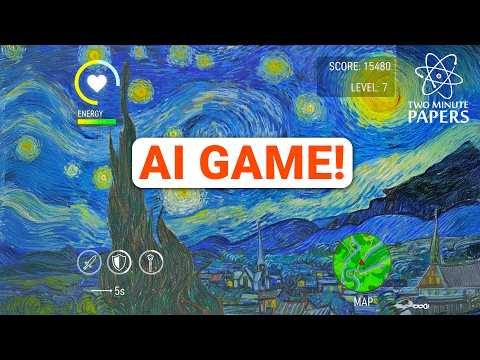
The field of artificial intelligence (AI) continues to push the boundaries of creativity and practicality. One of the most recent innovations is Magica 2, a groundbreaking AI that can transform a static image into a playable video game. With advancements over previous models like Genie 2 and Genie 3, Magica 2 offers exciting possibilities for integrating art and gaming. This article delves into the intricacies of Magica 2, comparing it to its predecessors, exploring its operational mechanics, and assessing its current limitations and future potential.
Introduction to Magica 2: Revolutionizing Video Game Content Generation
Magica 2 is an advanced AI developed to convert static images into fully immersive video games. This technology is an impressive leap forward, providing a new dimension to how we interact with art and images. Imagine stepping into Van Gogh’s “Starry Night” and navigating through its starry expanses—Magica 2 makes this surreal experience possible. This AI has enormous potential in revolutionizing video game content generation, simplifying the creative process, and expanding the types of interactive experiences available to users.
Comparing Magica 2 to Previous Models: Genie 2 and Genie 3
To truly grasp the novelty of Magica 2, it’s worthwhile to compare it to its predecessors, Genie 2 and Genie 3. Genie 2, although innovative, faced critique for its inability to maintain coherence, often likened to a goldfish with a fleeting memory. Genie 3 improved upon this considerably, providing more consistent and immersive gameplay, albeit within a limited timeframe of about ten minutes. Magica 2 surpasses these limitations with its advanced diffusion world model, shorter latency, and significantly improved predictive capabilities, making interactions smoother and more lifelike.
Operational Mechanics: How Magica 2 Works
At the core of Magica 2’s functionality is the diffusion world model, a technique that predicts future frames based on the current frame and player actions. This model operates similarly to a storyteller creating a flipbook, where each action smoothly transitions into the next, offering players a consistent and engaging experience. The AI leverages its knowledge of past frames to guide gameplay and adapt to user interactions, providing a more coherent visual storytelling compared to previous models.
Personal Experiences and Early Impressions
Those who have interacted with Magica 2 report varied experiences. Some games produced are highly engaging and fun, while others fall short, indicating that while the technology is promising, it is still in its nascent stages. Early users have been advised to keep expectations measured, as the tech demo version may have imperfections, such as erratic character control. Despite these limitations, the consensus remains that Magica 2 marks a significant technological milestone in AI gaming.
Current Limitations and Future Prospects
Magica 2 is not without its flaws. One notable limitation is the decrease in quality over extended playtime, an issue compounded by imperfect character control which can lead to unpredictable movements. However, these are expected hurdles in the development of new technology. As AI continues to evolve, we can anticipate rapid advancements that will likely address these limitations. The promise of Magica 2 lies in its potential for growth, with developers and users alike excited about the continuous improvements foreseeable in its future iterations.
In conclusion, Magica 2 emerges as a groundbreaking AI with the promise to transform static images into dynamic video game experiences. While there are still challenges to overcome, the advancements it brings over previous models like Genie 2 and Genie 3 are commendable. As we look forward to future developments, the potential of AI in revolutionizing video game content generation remains boundless. Whether you’re a developer, a gamer, or an AI enthusiast, Magica 2 is certainly a technology worth watching.